In honor of Lincoln’s birthday on February 12th and Valentine’s Day today, I decided to kick off our Bicentennial Bakes series featuring historic recipes from our archives with Mary Todd Lincoln’s Courting Cake, the “best cake Abraham Lincoln had ever eaten,” according to Alex Prud’homme’s Dinner with the President!
This recipe comes from Hildene’s 1982 cookbook, Hildene Hospitality Then and Now. An alternate version of the recipe can be found at the National Parks website here, but the Hildene Hospitality recipe is transcribed below:
Mrs. Lincoln’s White Cake
Yield: 2 9-inch layers
1 cup butter
2 cups sugar
3 cups flour
1 cup milk
1 cup blanched and toasted almonds, chopped
3 teaspoons baking powder
6 egg whites
1 teaspoon vanilla
1 teaspoon almond extract
- Cream sugar and butter.
- Sift dry ingredients together. Add to butter and sugar mixture, alternating with milk.
- Stir in nuts and beat well.
- Fold in beaten egg whites and vanilla and almond extract.
- Bake in two greased layer pans for 25 minutes at 350 degrees.
- Frost as desired.
Interested in what I did? Check out my process under the cut!
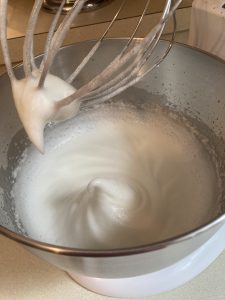
Instead of starting with creaming the sugar and butter, as I only have one mixer, I started off by separating the eggs and beating the whites to stiff peaks. It’s very important to whisk the egg whites in an impeccably clean (as Julia Child would say) bowl, as any amount of grease will cause the whites not to whip up properly. I remarked while doing so how much Mrs. Lincoln must have loved her husband; separating and whisking the egg whites by hand was no small feat before the days of electric mixers, I’m sure! I then put the egg whites in a separate bowl to wait while I did everything else, cleaning the bowl to use for the rest of the batter.
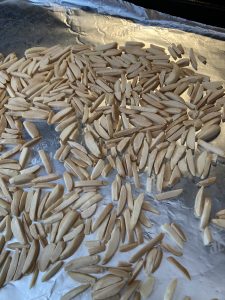
Next up was toasting the almonds: thanks to having blanched and slivered almonds readily available, I simply readied a sheet pan and put them in to toast. I only toasted them for about five minutes, or until fragrant, as nuts can burn incredibly easily.
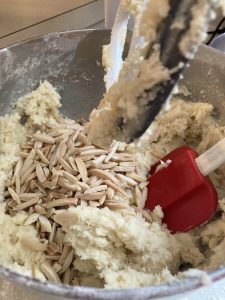
Then, I creamed the butter and sugar: a pretty standard thing that anybody who dabbles in baking will be familiar with. Make sure the mixture is good and fluffy, which usually takes a few minutes. Then came the nuts, mixed in until well incorporated, followed by the dry team. A lot of older recipes call for sifting dry ingredients, like this one, though your mileage may vary on how necessary that is these days due to a much more refined milling process. Either way, for the sake of authenticity, I sifted them together, then added it to the burgeoning batter, being sure to add milk periodically so that the kitchen didn’t explode into a floury mess (too much, at least!).
The batter at this point was pretty thick and stiff, especially after adding the almonds, not the usual consistency of cake batter I was used to, so I was beginning to get a little nervous. Once I added the vanilla and almond extract (a generous teaspoon of vanilla and more of an even teaspoon of almond, as a little goes a long way), it loosened up a bit, and it only loosened more once I folded in the waiting egg whites. It takes a good long while of careful folding and cutting the whites into the batter (not with a knife, but with a spatula, for those less traveled in the baking world) in order to make a nicely aerated, more manageable batter, so don’t get discouraged and do your best to keep at it!
From there, it was pretty easy to divvy up the mixture into my two trusty 9 inch baking pans and set them in the oven to bake. A short 25 minutes later and they looked pale, golden brown and ready to eat!
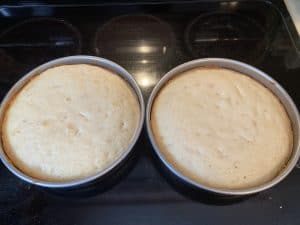
You may have noticed that the last step of the Hildene recipe is to “Frost as desired,” but no frosting recipe follows (instead, we see a charming recipe for a “Bride’s Happiness Cake,” which, alongside recipes like “Elephant Stew” or “Recipe for Friendship,” are a not uncommon sight in older, regional cookbooks, perhaps as a form of copy protection by the publisher). I did some research and found that the most common frosting recipe back in the day was a recipe called Ermine Frosting, which is also known as Boiled Milk or Cooked Flour Frosting (I promise, it tastes better than it sounds!). So, with some (albeit well-educated) creative license, I decided to use King Arthur’s Ermine Flour Frosting recipe to go with it.
First off, I measured out the sugar and the flour, whisking them together. Since I wasn’t sure whether to add the milk all at once before beginning to cook or periodically afterward, I added it all at once for the most part, adding it in small increments and making sure the mixture was as well mixed as possible. I then set the mixture over medium heat, whisking continuously until it began to come together and thicken. This took much longer than I anticipated, but I blame my notoriously dodgy old stove. Even with continual whisking, I still got some brown clumps from where the sugar and flour stuck to the bottom of the pot, so I think next time I make this, I’ll definitely add the milk more piecemeal to prevent those lumps (and maybe drop the heat a little).
From there, the recipe said to put it in the electric mixer and continue to mix until it cooled down to below 80 degrees: my thermometer is not very accurate, so I went by feel using my finger to test if it was cool enough (I figured lukewarm / room temperature would be about right). This, I’ll admit, was more of an educated guess than anything else. I then added the butter, about one to two tablespoons at a time, sometimes turning the mixer up to a higher speed in order to incorporate the butter better (though King Arthur says to keep it on low throughout, which is probably fine, I just got anxious). I was very pleased with how smoothed out it got once all the butter was added, but it still looked a bit grainy to me. Once I added the vanilla and continued to beat it on high, it became gloriously light and fluffy.
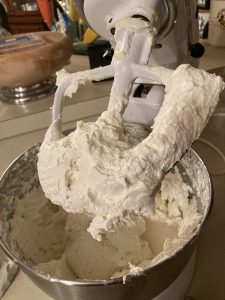
Naturally, it’s the cook’s job to give it a little taste, just to make sure it’s good: for possibly the most bizarre frosting I’ve ever made, it came out delicious and wonderfully fluffy, somewhere between a buttercream (though much less rich and dense) and a whipped cream frosting in consistency. I was thrilled! I then frosted both cakes and garnished with some more toasted almonds, as I had some left over.
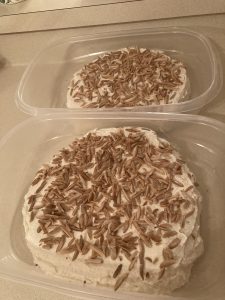
While I’m not sure if this cake is the best I’ve ever tasted– though I think it’s up there for sure– I can say that it is absolutely evident how much Mary Todd Lincoln must have absolutely adored Abraham. This was a lot of work even for me in my quasi-modern kitchen with electric appliances: I cannot possibly begin to fathom how much time, effort, energy, and most of all love that Mary (as, according to Alex Prud’homme’s amazing book, Dinner with the President, Mary Todd did do much of the cooking and baking herself) put into preparing this.
May love like Mary Todd and Abraham’s find us all… though hopefully with a much happier ending. Happy Valentine’s Day, Happy Presidents’ Day, and Happy Birthday to Abraham Lincoln!